

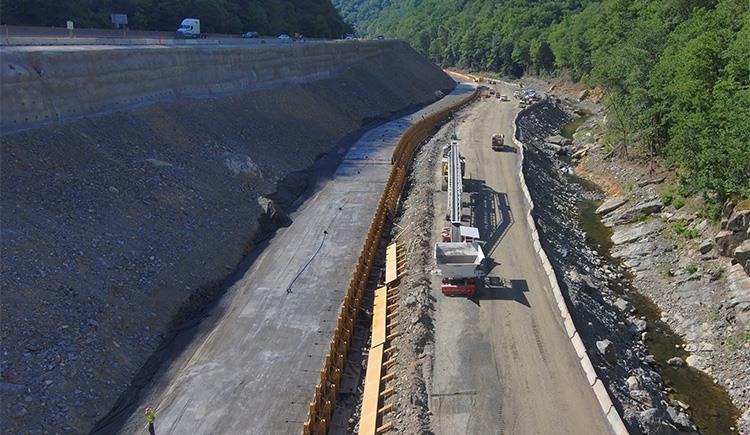
New geotechnical information shows bedrock is deeper than previously known, increasing the amount of work needed to rebuild the critical Smoky Mountain corridor.
HARMON DEN, N.C. (Smokies.LIVE Travel Center) — Reconstruction of Interstate 40 through the Pigeon River Gorge is now expected to cost approximately $2.8 billion, a significant increase from the roughly $2 billion estimate announced earlier this year, as new geotechnical information reveals deeper bedrock beneath portions of the damaged interstate.
The North Carolina Department of Transportation now estimates that four lanes of I-40 could be restored through the gorge by late 2029.
NCDOT said the estimate remains subject to change as engineers continue designing and constructing the largest reconstruction project in the department’s history.
The five-mile stretch of I-40 through the Pigeon River Gorge was destroyed or severely damaged by Hurricane Helene, which sent massive amounts of water through the narrow corridor between steep mountainsides and the Pigeon River.
For motorists, businesses and tourism officials throughout the Smoky Mountain region, the interstate is a critical transportation link connecting Western North Carolina with East Tennessee and the rest of the Southeast.
NCDOT officials said the latest cost increase is largely tied to new information about conditions beneath the roadway.

Deeper bedrock creates bigger construction challenge
As access to the construction site has improved, engineers have been able to conduct more extensive testing from the causeway — roughly every six feet — rather than relying primarily on testing performed at interstate level.
The testing has revealed significant variations in the depth of bedrock.
In some areas, bedrock is exposed at the surface. In other locations, it is more than 50 feet below the surface.
Samples collected from river elevation indicate that bedrock is deeper than earlier testing suggested.
That means crews must install longer steel piles to reach stable bedrock, increasing both construction costs and the time needed to complete portions of the project.
“This is the most complex reconstruction NCDOT has ever conducted, and we remain focused on delivering the safest, most durable solution while carefully managing taxpayer dollars,” N.C. Transportation Secretary Daniel Johnson said.
Johnson said the department is continuing to look for ways to reduce costs and accelerate the schedule without sacrificing the long-term durability of the interstate.
Rebuilding for the next extreme storm
NCDOT said the reconstruction is being designed to withstand the forces that caused the catastrophic damage during Hurricane Helene.
The project includes roller-compacted concrete walls, interlocking pipe pile walls and other structural components intended to provide greater protection against hydraulic forces from the Pigeon River.
The goal is not simply to reopen I-40, officials said, but to rebuild the corridor to be more resilient to future extreme weather events.
“History shows us that I-40 in the Gorge is vulnerable to flooding and failure, and not addressing the vulnerabilities now would result in the same damages at some point in the future,” said Wesley Grindstaff, NCDOT’s Division 14 engineer.
Grindstaff oversees highway operations in the 10 westernmost counties of North Carolina.
“The cost and consequence of slope failure is very high along this critical transportation corridor,” he said.
NCDOT considered several alternative construction approaches, including tunneling, a viaduct, a new alignment, rip-rap, pile-panel walls and secant walls.
Officials said the alternatives did not meet the project’s requirements for constructability, schedule, federal reimbursement or maintaining traffic during construction.

Building while designing
NCDOT is using a Construction Manager/General Contractor, or CMGC, delivery method, allowing design, engineering and construction to proceed at the same time.
The approach has allowed the department to restore interstate access while reconstruction continues.
Early cost and schedule estimates were developed using the information available during the initial stages of data collection and design.
As construction has progressed, crews have gained additional opportunities to study the ground beneath and around the damaged interstate.
Work such as soil-nail wall support, construction of the causeway and excavation of loose material has provided engineers with additional information to refine the plans.
NCDOT said experts in hydraulics, geotechnical engineering, geomorphology, environmental engineering and structural engineering are working together throughout the project.
Under the CMGC process, NCDOT selected Ames Construction through a competitive procurement process.
Ames is participating in the design and providing input on construction methods, pricing and scheduling.
Officials said that early collaboration helps identify risks, manage costs and potentially shorten the construction schedule compared with a traditional bid-build approach.
“Our responsibility is to make the best decisions we can with the information available and adjust as better information becomes available,” Grindstaff said.
“We will continue looking for opportunities to save time and money, but our primary commitment is to build this interstate to withstand the same type of event in the future.”
A major connection for the Smokies
The reconstruction has implications well beyond the immediate construction zone.
I-40 is one of the primary routes between the Great Smoky Mountains region and Western North Carolina, carrying residents, visitors, commercial traffic and emergency services through the mountains.
Until the full four-lane corridor is restored, travelers will continue to face an important transportation gap across the Pigeon River Gorge.
NCDOT said it continues to evaluate opportunities to accelerate the late-2029 target while maintaining its focus on building a stronger and more resilient interstate.
For the Smoky Mountain region, the project represents both a massive engineering undertaking and a critical step toward restoring one of the area’s most important transportation connections.
Smokies.LIVE Travel Center will continue following the I-40 Pigeon River Gorge reconstruction and its impact on travel between Tennessee and Western North Carolina.
No responses yet